The All-or-Nothing Routine Myth: How to Keep a Fitness Habit on a Busy Day
An all-or-nothing fitness routine can turn a missed session into a lost week. Compare three ways to scale practice and keep a workable rhythm.
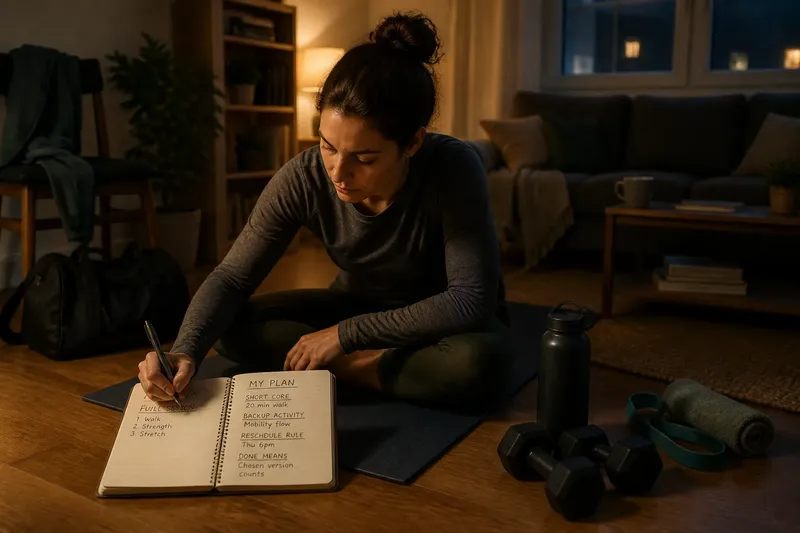
The most common mistake with an all-or-nothing fitness routine is treating the planned session as the only session that counts. A late meeting, a crowded evening, or low energy then turns a shorter workout into “nothing,” even when a small amount of movement would have fit. That rule can make a routine brittle: one disruption becomes a reason to wait for a perfect day.
A more useful routine has options. Keep the full session for days when it fits, and decide in advance what a smaller version looks like. The smaller version is not a substitute you must use every time; it is a practical choice for keeping movement in your week when circumstances change.
What does a smaller routine actually preserve?
It preserves the decision to show up, not the exact amount of exercise in the original plan. That distinction matters. If your schedule leaves room for only a brief walk or a few familiar movements, you can still follow through on the part of the routine that fits without pretending you completed the full session.
Think of a routine as a pattern with adjustable size. The full version might include a walk, strength exercises, and time to stretch. A smaller version might be one activity you can begin and finish without rushing. Both can belong to the same routine if you define them before the pressure of a busy day arrives.
Scaling down should not mean trying to cram the full session into less time. That can turn a manageable option into hurried, uncomfortable practice. Instead, choose what to keep: perhaps the movement you most enjoy, the activity easiest to access, or a simple action that helps you maintain your usual schedule. Skip what does not fit and leave it there.
Which approach suits your schedule?
There are three useful ways to shape a flexible routine: keep a short core, switch to a smaller activity, or move the session to another time. Each solves a different problem. Pick one as your default, then keep the others available when the day calls for them.
Option one: Keep a short core
Choose a brief version of the same activity you planned to do. If your regular routine includes a walk, for instance, the short version can be a walk on a nearby route instead of the longer outing. If you do a familiar set of bodyweight movements, select a few that you already know how to perform comfortably.
This suits people who find it easier to stick with a familiar cue and activity. It also keeps the decision simple: do the core, rather than debate whether the entire plan is possible. The trade-off is that the core still needs to fit your space, energy, and available time. A short version should feel intentional, not like a frantic attempt to tick off every part.
Option two: Switch to a smaller activity
Keep the time or general intention, but change the activity to something easier to fit. A planned gym visit might become a relaxed walk near home; a longer indoor session might become gentle mobility movements in a clear patch of floor. Choose an alternative that does not require new equipment or a complicated setup.
This suits people whose plans often collide with travel, access, or schedule changes. It offers flexibility without requiring the day to be rearranged. The trade-off is that the replacement may feel less like the activity you were looking forward to. Keep the purpose modest: it is a smaller option for this occasion, not a claim that every activity serves the same goal.
Option three: Move the session to another time
If a shorter version is not appealing or practical, reschedule the full session once, to a specific opening that genuinely exists. “Tomorrow after work” is clearer than “later this week.” If that time is already crowded, choose another option rather than creating a chain of postponed sessions.
This suits people who prefer a complete session and can identify a realistic replacement slot. The trade-off is that moving a workout can squeeze rest, family commitments, or other activities. Treat the new time as an offer, not an obligation: if it does not fit, use a smaller version or let that session go without turning it into a verdict on the whole routine.
How can you choose before a busy day?
Decide what counts as the smaller version while you are calm. Write it in a note on your phone or add it beside the routine in a paper calendar. Keep the wording concrete enough that you will not have to invent a new plan when you are tired.
- Name the full session: Record the activity and its usual sequence, such as a neighborhood walk followed by familiar strength movements.
- Choose one short core: Identify the part you can do without special preparation or rushing.
- Pick a backup activity: Name a convenient alternative for days when the original setting or equipment is unavailable.
- Set a rescheduling rule: Move the full session only when you can name a real time that does not crowd out another commitment.
- Define what “done” means: Decide that completing your chosen version is enough for that day; do not add extra work to compensate.
- Review the plan after disruptions: If the short version repeatedly proves impractical, replace it with a simpler choice.
These choices make the routine easier to use, but they do not require you to complete some form of movement every day. Rest, illness, discomfort, and changing responsibilities may call for skipping a session. If pain or a health concern affects what is appropriate, seek guidance from a qualified health professional.
What if the smaller version feels like failure?
That feeling often comes from comparing the day with the original plan instead of comparing it with what was realistically available. A smaller session does not have to match the full session’s duration, difficulty, or purpose. Its value is that it gives you a workable choice without asking you to ignore the day you are actually having.
Try describing the result accurately: “I did the short version,” rather than “I failed to do the real workout.” The language is not a trick to make every choice feel triumphant. It simply distinguishes a deliberate adjustment from abandoning the routine because the ideal plan no longer fits.
Which routine option should you choose?
Should I shorten the same workout or switch activities?
Shorten the same activity if familiarity helps you begin and it still fits comfortably. Switch activities if the original setting, equipment, or schedule is the obstacle and you have a straightforward alternative.
Does a brief session count if it is not the full plan?
It counts as the version you chose to do, not as a full session by another name. Keeping that distinction lets you value the follow-through without overstating what you completed.
When should I reschedule instead of scaling down?
Reschedule when you have a specific opening soon and moving the session will not crowd out rest or another commitment. If there is no realistic opening, choose a smaller option or leave the session out.
How often should I use the smaller version?
There is no universal schedule for it. Use it when the planned session does not fit, then consider whether recurring obstacles mean your regular plan needs adjusting.
What does a workable adjustment look like?
Say you planned to walk after work, but a delayed bus leaves little time before dinner. You had already chosen a short route near home as your smaller version. You take that route at an easy pace and finish before dinner; the observable result is that you completed the planned fallback, rather than rushing through the longer walk or carrying it into an already crowded evening.
The useful lesson is not that every disrupted plan needs to be rescued. It is that you can distinguish between a day when a smaller option fits and a day when rest or another priority matters more. Keeping both choices legitimate makes the routine easier to adapt without turning every change into an all-or-nothing decision.
For an all-or-nothing fitness routine, write down one short core, one alternate activity, and one realistic rescheduling rule. Keep the note where you plan your week. When a session no longer fits, choose among those options—or skip it when that is the sensible choice—without asking a single changed day to decide whether your routine still exists.